
A seller’s price travels fast across WhatsApp. The machine doesn’t. In African operating corridors, that “competitive” quote on a used excavator or dozer can conceal cost layers that transform clean procurement into budget hemorrhage. The gap between advertised price and corridor reality isn’t closed by harder negotiation—it requires evidence-based equipment valuation tied to route-specific total cost of ownership.
Why This Decision Keeps Breaking Down
Procurement teams face relentless pressure: deliver machines fast, hit CAPEX targets, avoid downtime penalties. Sellers present clean numbers and recent photos. Yet three forces consistently derail the decision:
Corridor friction vanishes at quote stage. Port congestion, escort requirements, axle-load compliance, and border sequencing convert “landed in 21 days” promises into 6–10 week realities on actual routes.
Condition variance accelerates brutally. High-hour undercarriages, contaminated hydraulics, and cooling systems designed for temperate climates degrade rapidly under African heat, dust, and steep grades. Strong used-equipment evaluation goes beyond “starts and runs” with undercarriage wear, rollers, and sprockets driving real reliability outcomes.
Specification mismatch costs compound. Tier 4 Final engines expect ultra-low sulfur fuel and dealer tooling not uniformly available along SADC, EAC, and ECOWAS corridors. Wrong emissions tiers, inadequate guarding, or mismatched cooling packages silently convert into unplanned retrofits and downtime.
Result: the “deal” price gets approved; the operating corridor reveals the real cost.
Where the Commercial Damage Starts
The damage rarely stems from one catastrophic miss. It accumulates through predictable, systematic oversights:
Logistics and handling leakage begins with freight decisions made on rate alone, ignoring discharge port capabilities, breakbulk queues, and weather windows. Corridor selection overlooks weighbridge density, preferred escort routes, and public holiday closures that spike layover costs.
Taxes, duties, and valuation friction emerge when customs reference values diverge from invoiced amounts. Low declared values trigger reassessments and penalties; inflated ones distort duties without improving claim recoveries.
Condition-to-corridor mismatch surfaces when quarry machines with near-expired undercarriages get repurposed for haul road work. Rebuild allowances get underestimated or excluded entirely.
Cooling and filtration gaps appear when systems undersized for high-dust, high-ambient operations require unbudgeted fitment of pre-cleaners, heavy-duty coolers, reversible fans, and rock protection.
Supportability voids open where dealer coverage thins outside capitals and slow-moving parts sit in offshore depots. North American or European SLA assumptions collapse in Luapula, Tete, or Turkana.
Finance and insurance misalignment occurs when financed amounts or declared values diverge from corridor-true fair market value, creating overexposure today and claim-stage disputes tomorrow.
If these patterns match your current tender or auction target, request a valuation evidence review for the specific make, model, and corridor to price the machine you’ll actually operate.
What a Controlled Route Changes
A controlled route replaces optimistic quotes with valuation evidence through six disciplined moves:
Corridor-adjusted market value intelligence benchmarks achieved prices for identical make/model/year/condition combinations, then normalizes for hours, rebuild status, attachments, and corridor liquidity. This delivers used equipment price validation, not seller narrative.
Condition and remaining-life modeling provides independent, component-level inspection mapped to resale impact: undercarriage, swing bearing, pumps, finals, A/C capacity, and structural stress points. Maintenance quality materially shifts performance and resale value across the asset lifecycle.
Landed cost and compliance build-up calculates route-by-route total cost including origin handling, ocean transit, discharge, customs processes, duties according to HS codes, transit bonds, escorts, permits, weighbridge fees, and last-mile risks. “To-be-confirmed” lines get replaced with priced scenarios.
Spec-to-duty verification maps emissions tiers, fuel quality tolerance, filtration packages, guarding, ROPS/FOPS, and attachment compatibility to operating duty cycles. Retrofit scope gets identified before purchase.
Finance and insurance alignment presents insurance value clarity through fair market value documentation, declared value rationale, and replacement value discipline to reduce claim-stage disputes. Lenders see collateral strength supported by valuation evidence.
Acceptance and fallback terms establish evidence-based acceptance criteria, punch-list timelines, and remedial pricing pre-agreed with sellers and shippers. Surprises shift from your P&L to contractual remedies.
Outcome: asset value confidence before funds transfer. Procurement approves defensible numbers with corridor-true TCO backed by machine value verification.
How It Plays Out in Real Corridors
Common African routes where advertised prices routinely detach from true costs—and how controlled routes correct them:
Durban → Copperbelt (Zambia/DRC) typically misses Beitbridge timing, escort permitting, wet-season conditions, and port delays. Tier 4 machines encounter ULSD gaps inland. Controlled response: corridor-specific TCA with seasonal timing, axle-load compliant transport, emissions viability checks, and retrofit risk pricing.
Mombasa → Kampala/Kigali underestimates weighbridge queues, border sequencing at Malaba/Busia, and dust loading on cooling systems. Auction wins with worn undercarriages arrive under-budgeted. Controlled response: inspection focus on undercarriage and cooling; priced pre-fit of heavy-duty filtration; broker-verified duties baked into landed costs.
Abidjan/Tema → Sahel projects overlooks customs valuation uplifts, convoy rules, and thin dealer coverage outside capitals. Controlled response: market value intelligence aligned to customs reference bands, supportability mapping, and buffer stock costing.
Walvis Bay → Northern Namibia/DRC underestimates desert heat, fine dust abrasion, and long last-mile legs that magnify transport choices. Controlled response: spec-to-duty verification for cooling systems, track compound matching, and last-mile configuration avoiding mid-route re-rigging.
Commercial Takeaway
The cheapest advertised machine rarely survives contact with African corridors. Evidence-based equipment valuation converts seller prices into corridor-true fair market value and defensible total cost, enabling capital commitment without inheriting hidden risk.
Share your machine details and intended route. We’ll return a scoped market evidence and value validation report for setting price, aligning finance and insurance, and briefing operations. Include machine type, make, model, year, hours, condition, location, destination, duty cycle, ownership context, timeline, and valuation purpose.
Next step
Review the first published article
The first live markdown publish will replace this bootstrap state with the client's own governed content.
Read next
Related posts
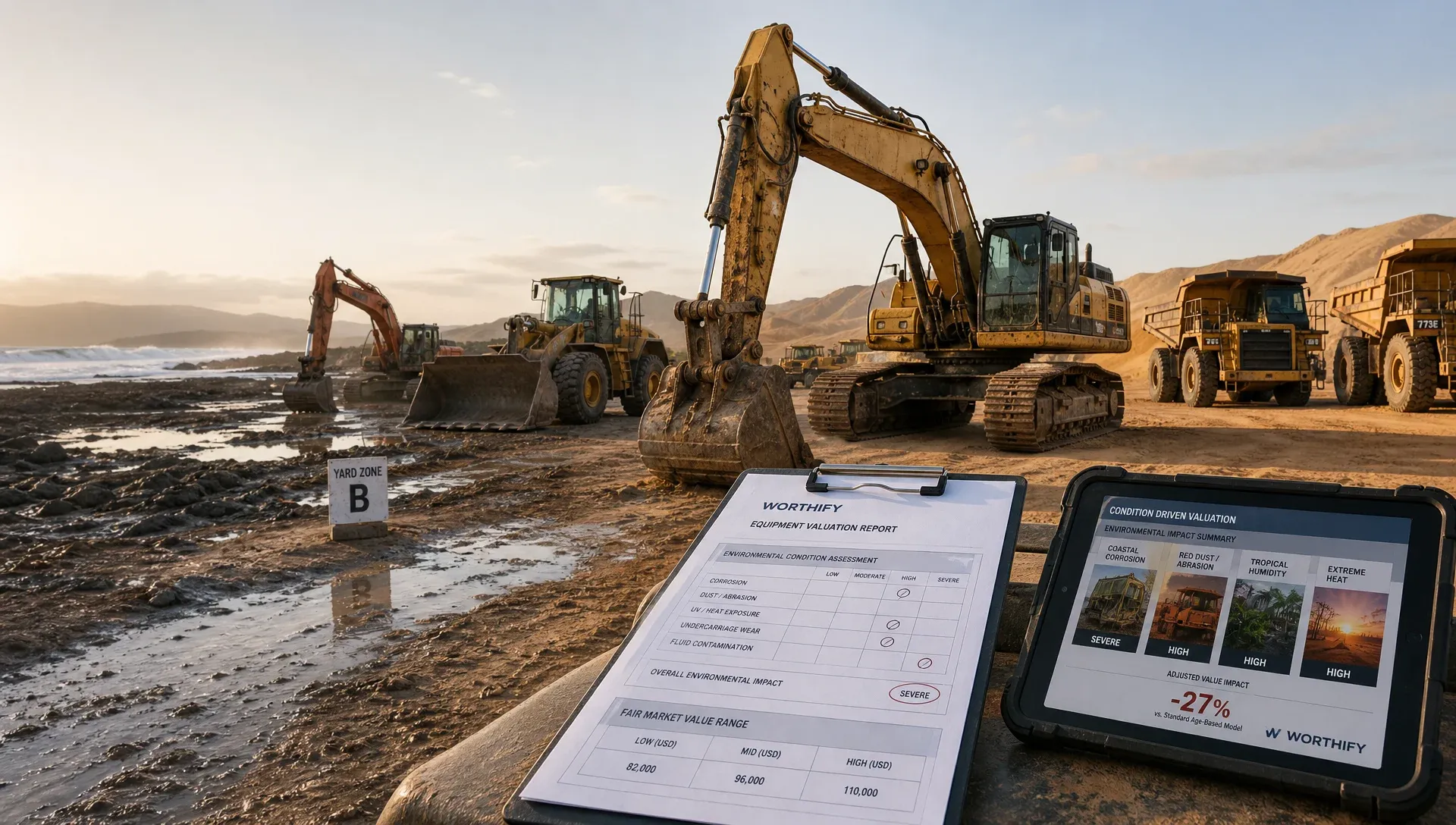
Is Your Balance Sheet Wrong? Why Environment Beats Age in Machinery Valuation
Standard depreciation models create a valuation blind spot. Learn how harsh operating environments destroy machinery value faster than age suggests, creating hidden balance sheet risk and insurance disputes.